
Starlink
Michael Nicolls (VP of Starlink Engineering)
Data verified as of Jul 17, 2026
Summary
Starlink is SpaceX's satellite internet division and the largest satellite constellation ever flown, with more than 10,700 active satellites in low Earth orbit serving 12M+ customers across 160+ countries as of June 2026. Reported as SpaceX's Connectivity segment, it generated $11.39B of revenue in 2025 (61% of SpaceX's total, up ~49% year over year) with $7.17B of segment adjusted EBITDA — the profit engine funding Starship and SpaceX's AI-compute buildout. Beyond fixed broadband, Starlink runs maritime, aviation (42 airlines have Starlink Wi-Fi), and Direct to Cell services: the July 2025 T-Satellite launch with T-Mobile made satellite-to-phone service commercial in the US, and the FCC-approved ~$17B EchoStar spectrum purchase (May 2026) positions 'Starlink Mobile' to become a direct consumer carrier competing with AT&T, Verizon, and T-Mobile. Next-generation V3 satellites — roughly 1 Tbps of downlink capacity each, launchable only on Starship — underpin plans for gigabit consumer service and a target of ~25M users by year-end 2026.
Main Products

The largest satellite constellation ever flown: 10,700+ active satellites in low Earth orbit delivering broadband across 160+ countries, with laser inter-satellite links and multiple weekly Falcon 9 deployment launches.
V2 Mini satellites launch on Falcon 9 several times a week. Next-generation V3 satellites (~1 Tbps downlink each, only launchable on Starship) begin deployment once Starship returns to flight — the first batch of 20 was aboard the aborted July 16, 2026 Flight 13.
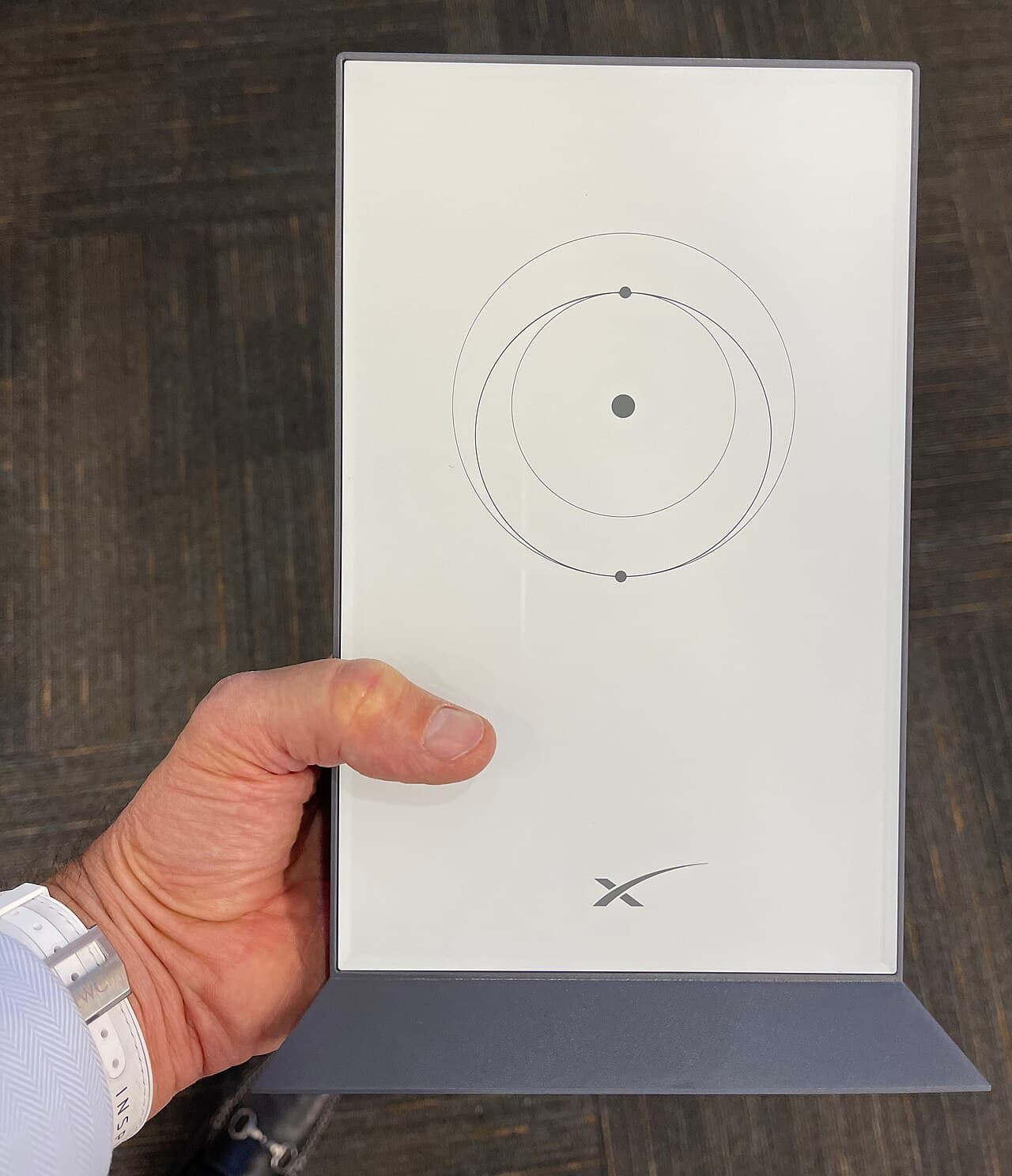
Self-install phased-array user terminals: the Standard Kit ($349), the portable Starlink Mini, and the enterprise-grade Performance dish ($1,999), with terminal manufacturing in Bastrop, Texas.
Gigabit-class consumer service is planned for 2026 on the back of V3 capacity and 2026 plan upgrades to the Performance dish (400+ Mbps today).
Satellite-to-phone service using 650+ dedicated satellites that act as cell towers in space, providing messaging, voice, data, and IoT connectivity to unmodified phones — commercial in the US since July 2025 as T-Mobile's T-Satellite and live with carrier partners worldwide.
Described in October 2025 as the world's largest 4G coverage provider. The next step is Starlink Mobile: direct-to-consumer service on the ~$17B EchoStar mid-band spectrum approved by the FCC in May 2026, with larger V2 direct-to-cell satellites expected via Starship.
What's Next
Deploy Starlink V3 satellites at scale via Starship
The larger V3 satellites — roughly 1 Tbps of downlink each, targeting greater-than-100x available bandwidth at a lower 350 km altitude — can only launch on Starship. The first 20 operational V3s were aboard Starship Flight 13, aborted seconds before liftoff on July 16, 2026 with a retry expected within days; SpaceX's stated plan is for Starship to begin delivering operational V3s during 2026.
Scale toward 25M customers and launch gigabit service
After crossing 12M customers on June 4, 2026 (~27,700 net adds/day), Starlink targets roughly 25M active users by year-end 2026 and plans to debut gigabit-class consumer service on the back of V3 capacity — Elon Musk claims a 10 Gbps symmetric peak has been demonstrated in Utqiagvik, Alaska.
Launch Starlink Mobile as a direct US consumer carrier
Starlink is shifting from a behind-the-scenes carrier-partner model (T-Mobile US, One NZ, Rogers, KDDI, Optus, Telstra, Salt, Entel, Kyivstar, Virgin Media O2, and others) toward selling Starlink Mobile directly to consumers. The FCC's May 12, 2026 approval of the ~$17B EchoStar acquisition gave it ~65 MHz of exclusive-use, contiguous nationwide mid-band spectrum (AWS-4/AWS-3/H-Block, 1.9–2.2 GHz), with licenses fully transferring by ~November 2027. On June 26, 2026 Gwynne Shotwell told IPO-roadshow investors SpaceX plans to challenge AT&T, Verizon, and T-Mobile head-on and may build out its own terrestrial network.
Operations & Revenue
Commercial service since 2020 across residential, roaming, enterprise, maritime, aviation, and direct-to-cell offerings. The constellation stands at more than 10,700 active satellites with V2 Mini satellites launching on Falcon 9 multiple times per week; deployment of the far larger V3 satellites is gated on Starship — the first attempt to orbit 20 operational V3s (Starship Flight 13) was aborted seconds before liftoff on July 16, 2026, with a retry expected within days. Starlink is SpaceX's profit engine: $11.39B of 2025 revenue at $7.17B segment adjusted EBITDA.
Revenue Streams
Residential & Roam Subscriptions
Consumer broadband at ~$50–$120/month (US standard $120) plus Roam plans at $150–$200/month for RVs, campers, and travelers; hardware from the $349 Standard Kit and the compact Starlink Mini.
Priority-data business plans and the Performance dish ($1,999) for enterprise sites, plus Starlink Dedicated Service (Bonded Gateway) offering dedicated Ka-band beams at up to ~20 Gbps symmetrical per gateway.
Priority-data maritime plans with a 99.9% network SLA for vessels and offshore operations.
In-flight Wi-Fi flying on 42 airlines in 2026, led by United (423 aircraft equipped), Qatar Airways (~140 aircraft), and Air France (~60% of fleet, fleetwide by end-2026).
Direct to Cell (Starlink Mobile)
Satellite-to-phone messaging, voice, data, and IoT sold through carrier partners — T-Mobile (US), Optus, Telstra, Rogers, One NZ, KDDI, Salt, Entel, Kyivstar, Virgin Media O2, Airtel Africa, Deutsche Telekom, and more — with a shift toward selling Starlink Mobile directly to US consumers on the EchoStar spectrum.
Key Metrics
Timeline
On May 12, 2026 the FCC approves SpaceX's EchoStar spectrum acquisition (with a $2.4B escrow condition), handing Starlink ~65 MHz of exclusive-use, contiguous nationwide mid-band spectrum in the 1.9–2.2 GHz range — the foundation for a direct-to-consumer Starlink Mobile carrier play.
SpaceX's May 20, 2026 S-1 discloses Starlink's financials for the first time: $11.39B of 2025 revenue (+49% YoY) at $7.17B of segment adjusted EBITDA. On June 4, 2026 Starlink announces it has crossed 12 million active customers across 160+ countries, adding ~27,700 customers per day.
T-Mobile's Starlink-powered T-Satellite service launches commercially on July 23, 2025 — the first US nationwide satellite-to-phone service. In September, SpaceX strikes a ~$17B deal for EchoStar's AWS-4 and H-block spectrum, its first exclusive direct-to-device spectrum. Starlink ends 2025 with 8.9M subscribers and $11.39B of revenue.