Nvidia, founded in 1993 by Jensen Huang, Chris Malachowsky, and Curtis Priem, invented the modern GPU (GeForce 256, 1999) and then — via the 2006 CUDA platform — turned it into the engine of the AI revolution. It is now the world's most valuable company at $5.11 trillion (July 2026), having crossed $4T in July 2025 and $5T that October. Fiscal 2026 revenue hit $215.9B (+65%), and the momentum accelerated: Q1 FY2027 (ended April 2026) delivered a record $81.6B (+85% YoY) with data center revenue of $75.2B, and Q2 is guided to $91B. The Blackwell Ultra GB300 platform drove the ramp, and at GTC 2026 Huang declared the seven-chip Vera Rubin platform — Vera CPU, Rubin GPU, NVLink 6, and a newly integrated Groq 3 LPU — in full production, with partner systems arriving in H2 2026 and roughly $1 trillion in cumulative Blackwell-plus-Rubin orders projected through 2027. Nvidia has also become the AI buildout's central dealmaker: up to $100B invested in OpenAI to deploy at least 10 GW of Nvidia systems, up to $10B in Anthropic, a key role in the $500B Stargate project, and millions of GPUs committed to Meta. The China business is the big casualty — export restrictions triggered a $4.5B charge in 2025, and despite a December 2025 deal allowing H200 sales with a 25% cut to the US government, shipments remain stalled and Nvidia's 10-K calls the company effectively foreclosed from China's data-center market. Competition now comes less from AMD than from customers' own silicon: Google TPUs, AWS Trainium, and Broadcom-built custom ASICs.
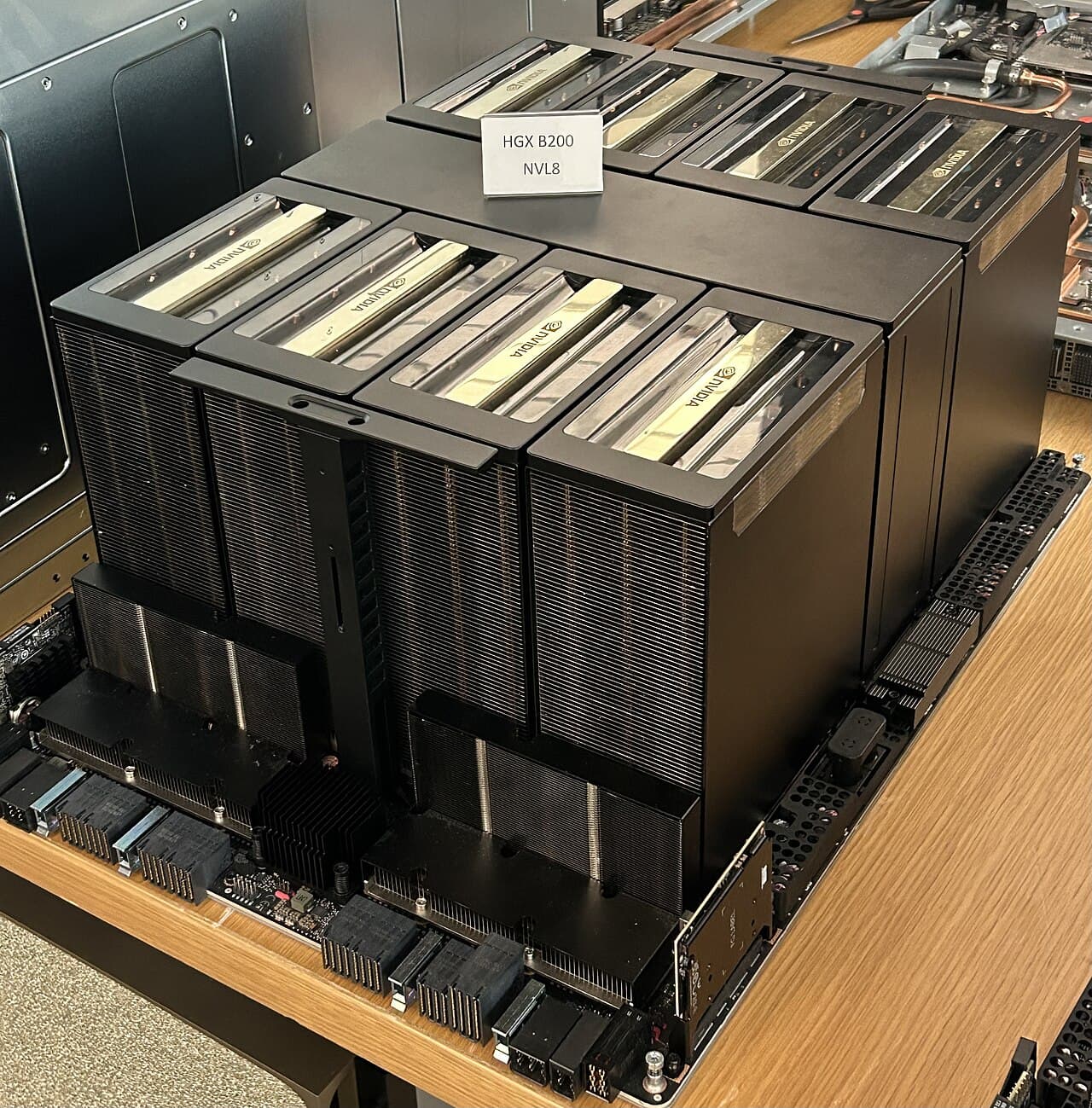
Nvidia's shipping flagship: rack-scale AI systems built around Blackwell and Blackwell Ultra GPUs — the GB300 NVL72 links 72 GPUs into one giant accelerator, delivering up to 50x better agentic-AI performance than Hopper per SemiAnalysis benchmarks. GB300 entered mass production in mid-2025 and has been the engine of record data-center revenue since.
GB300 shipping since September 2025; rack shipments projected to grow ~129% in 2026 to ~60k racks
Nvidia's next-generation seven-chip platform — Vera CPU, Rubin GPU, NVLink 6 switch, ConnectX-9, BlueField-4, Spectrum-6, and the Groq 3 LPU integrated after a December 2025 licensing deal. Rubin NVL72 racks train mixture-of-experts models with a quarter of the GPUs Blackwell needs and deliver up to 10x inference throughput per watt at a tenth the cost per token.
All seven chips declared in full production at GTC on March 16, 2026; partner systems and cloud instances (AWS, Google Cloud, Azure, OCI, CoreWeave) available H2 2026
Training efficiencyMoE training with 1/4 the GPUs of Blackwell
InferenceUp to 10x throughput/watt at 1/10 cost per token
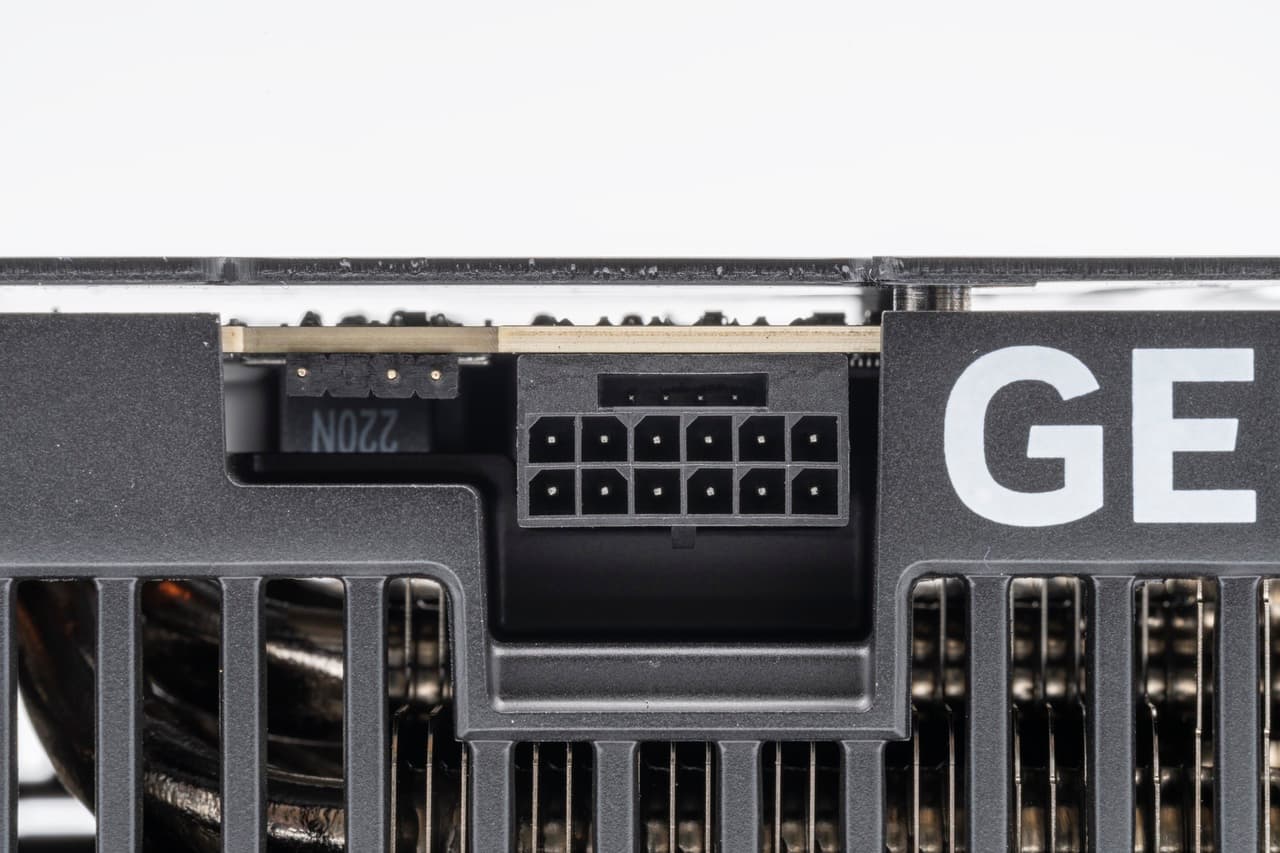
Blackwell-based gaming and creator GPUs, topped by the RTX 5090 ($1,999 MSRP, launched January 2025). FY2026 gaming revenue hit a record $16.0B, but supply to board partners was reportedly cut ~20% in 2026 to prioritize data-center silicon, pushing street prices 15–19% above MSRP.
Shipping but supply-constrained; DLSS 4.5 shipped and DLSS 5 previewed; no desktop refresh confirmed for 2026
DRIVE AGX Thor and DRIVE Hyperion power L4-ready vehicles from BYD, Geely, Isuzu, and Nissan plus Hyundai/Kia and Uber robotaxi programs, while Jetson AGX Thor — the Blackwell-powered 'robot brain' released August 2025 with 7.5x the AI compute of Orin — is the standard compute platform for humanoid-robot makers including Figure, Boston Dynamics, Agility, and Amazon Robotics.
Jetson AGX Thor generally available since August 25, 2025 ($3,499 devkit); FY2026 automotive & robotics revenue a record $2.3B (+39%)
Rubin NVL72 racks and cloud instances become available from partners — AWS, Google Cloud, Azure, Oracle, CoreWeave, Lambda, Nebius, and Nscale — with the volume ramp building through Q4. The pace of this transition (while Blackwell keeps selling) is the single biggest thing to watch in AI hardware.
H2 2026
First gigawatt of the OpenAI deployment goes live
The first 1 GW of the ≥10 GW OpenAI partnership deploys on the Vera Rubin platform, unlocking the first tranche of Nvidia's up-to-$100B progressive investment.
H2 2026
Rubin Ultra NVL576
The mid-generation upgrade scales to 576 GPUs per ~600 kW rack with 15 exaflops of FP4 inference and 365 TB of fast memory — a rack so power-dense it will force data-center redesigns.
H2 2027
Feynman architecture with Rosa CPU
The generation after Rubin — announced on Nvidia's roadmap with advanced 3D chip stacking — keeps the annual-cadence data-center platform train running into 2028.
2028
Track Record
2 of 3 announced dates hit · 1 missed
Launch Vera Rubin in 2026
Target 2026 · Resolved Mar 16, 2026
All seven Vera Rubin platform chips were declared in full production at GTC on March 16, 2026 — ahead of analyst expectations of early 2027 — with partner systems available H2 2026 as planned on the March 2025 roadmap.
Hit
Resume AI chip sales to China after the April 2025 H20 license requirement
Target 2025 · Resolved Feb 25, 2026
Despite a December 2025 presidential decision allowing H200 sales to China with a 25% cut to the US government, shipments stalled in an interagency review while Beijing pushed buyers toward Huawei; Nvidia's FY2026 10-K (February 2026) declares the company effectively foreclosed from China's data-center market, and guidance assumes zero China revenue.
Missed
Ship Blackwell Ultra (GB300) in H2 2025
Target H2 2025 · Resolved Sep 30, 2025
GB300 entered mass production in June 2025 and servers began shipping in September 2025, on schedule — the ramp went smoothly by reusing GB200 infrastructure and drove record data-center revenue through FY2026.
Apple briefly overtakes Nvidia as world's most valuable company
Apple briefly surpassed Nvidia as the world's most valuable company on July 17, touching about $4.88 trillion as Nvidia shares slipped roughly 3% to a market value near $4.84 trillion during an AI-chip selloff, before Nvidia edged back ahead by the close. It marked the first time in more than a year that Apple held the top spot, which Nvidia had claimed since June 2025. Investors have rewarded Apple's lighter capital-spending approach — its stock is up about 23% in 2026 — even as megacap AI names cooled.
Jul 17
Nvidia launches Cosmos 3 Edge robot model, forms Japan coalition
Nvidia on July 16 unveiled Cosmos 3 Edge, a 4-billion-parameter 'world model' for on-device vision reasoning and robot-action generation that runs on Jetson and edge GPUs, letting robots perceive and navigate physical environments in real time. During CEO Jensen Huang's visit to Tokyo, the company said Japanese industrial leaders — including FANUC, Fujitsu, Hitachi, Kawasaki Heavy Industries, Kubota, NEC, SoftBank, Sony and Yaskawa Electric — intend to join a new NVIDIA Cosmos Coalition to build open physical-AI models. Kawasaki said it plans to apply Nvidia's Cosmos, Isaac and Holoscan software to surgical-support, nursing-assistance and hospital-transport robots.
Jul 16
US official says 'very few' Nvidia H200 chips shipped to China
A senior U.S. trade official said on July 14 that only 'very few' of Nvidia's H200 artificial-intelligence chips have so far been shipped to China and Hong Kong, describing 'a very small quantity,' after Washington began issuing export licenses for the older Hopper-generation processor. The Trump administration agreed late last year to approve H200 sales to China in exchange for a 25% cut of the revenue, assessing buyers case by case against national-security conditions. The remarks suggest the resumption of China sales — potentially a meaningful new revenue stream for Nvidia — is still ramping slowly.
Jul 15
Nvidia halves Asian AI-chip buyer list in China crackdown
Nvidia has more than halved the number of Asian customers cleared to buy its AI chips, introducing a 'white list' of firms that passed tougher compliance checks meant to stop the processors from being diverted to China, the Financial Times reported July 14. The company has stepped up vetting in Singapore, Malaysia and Japan — with staff now visiting customers' data centers, verifying contracts and interviewing end users — and many smaller 'neo-cloud' providers that failed the initial review were dropped and must reapply. The U.S. Commerce Department is backing the effort, part of a Trump administration push to keep advanced Blackwell-class chips from reaching Chinese-linked entities through third countries.
Jul 14
Report says Nvidia's Kyber AI rack slips to 2028; Nvidia denies
Semiconductor research firm SemiAnalysis reported that Nvidia's Kyber NVL144 rack — a system packing 144 next-generation Rubin Ultra GPUs into a single NVLink domain — has slipped from 2027 to 2028 because its 'orthogonal backplane' printed-circuit midplane proved too defect-prone to manufacture at volume, and that a planned stopgap design was scrapped after customer pushback. Nvidia disputed the report, telling Bloomberg its 'road map is intact' and noting that its standard Rubin systems are already in full production. The two claims can both hold because the reported delay affects only the highest-density Rubin Ultra rack, not the base Rubin platform shipping in 2026.
Q1 FY2027 revenue grew 85% YoY to $81.6B with Q2 guided to $91B, and Jensen Huang projects roughly $1T in cumulative Blackwell-plus-Rubin orders through 2027. Supply remains the binding constraint — gaming GPU allocations were reportedly cut ~20% in 2026 to prioritize data center. Three risks dominate: China (the FY2026 10-K says Nvidia is effectively foreclosed from China's data-center market, and guidance assumes zero China revenue while the December 2025 H200 deal sits in interagency review); custom silicon (Google TPU, AWS Trainium, and Broadcom-built ASICs are a faster-growing threat than AMD); and AI-capex sustainability, with critics pointing to circular deals in which Nvidia invests in OpenAI, Anthropic, and CoreWeave, which in turn buy its chips.
Revenue Streams
Data center (compute + networking)
AI accelerators, rack-scale systems, and networking (NVLink, Spectrum-X, InfiniBand) for hyperscalers, AI clouds, and enterprises — $193.7B in FY2026 (+68%) and $75.2B in Q1 FY2027 alone, roughly 92% of company revenue.
Gaming / AI PC
GeForce RTX GPUs for gamers and creators — a record $16.0B in FY2026 (+41%), though supply is being deliberately constrained in favor of data-center production. From Q1 FY2027 this reports under the new 'Edge Computing' platform.
Professional visualization
RTX workstation GPUs and Omniverse for design, simulation, and digital twins — $3.2B in FY2026 (+70%).
Automotive & robotics
DRIVE autonomous-vehicle platforms (BYD, Geely, Nissan, Hyundai/Kia, Uber robotaxi partnerships) and Jetson robotics computers — $2.3B in FY2026 (+39%), the seed of what Huang calls the next trillion-dollar market.
Key Metrics
Employees
42,000 (as of Jan 25, 2026)
Est. Annual Revenue
$215.9B (FY2026, ended Jan 25, 2026, +65% YoY; net income $120.1B)
Market cap
$5.11T (Jul 10, 2026) — world's most valuable company
Latest quarterly revenue
$81.6B (Q1 FY2027, +85% YoY); Q2 guided to $91B
Data center revenue
$75.2B in Q1 FY2027 (+92% YoY; networking alone $14.8B, +199%)
AI accelerator market share
~80–85% of data-center AI accelerator revenue (2026 est.)
Gross margin
75.0% non-GAAP (Q1 FY2027)
Order book
~$1T in Blackwell + Rubin orders projected through 2027
CUDA developers
~6 million (GTC 2026)
Employees
42,000 (Jan 25, 2026)
Timeline
2026Record FY2026: $215.9B revenue, +65%
Fiscal 2026 (ended January 25, 2026) closes with revenue of $215.9B, data-center revenue of $193.7B (+68%), and GAAP net income of $120.1B, reported February 25, 2026.
2026GTC 2026: Vera Rubin platform in full production
On March 16, 2026, Jensen Huang announces all seven Vera Rubin chips in full production — ahead of analyst expectations of early 2027 — including the Groq 3 LPU integrated after a December 2025 licensing deal, and projects $1 trillion in Blackwell-plus-Rubin orders through 2027.
The quarter ended April 26, 2026 sets records across the board — $81.6B revenue (+85% YoY), $75.2B data center — alongside an additional $80B buyback and a dividend increase from $0.01 to $0.25 per share. Q2 guidance: $91B, assuming zero China data-center revenue.
2025China export restrictions force a $4.5B charge
In April 2025 the US requires licenses for H20 exports to China, triggering a $4.5B charge. A December 2025 deal allowing H200 sales with a 25% cut to the US government stalls in interagency review; Nvidia's 10-K later declares the company effectively foreclosed from China's data-center market.
2025First company to $4T, then $5T
Nvidia becomes the first company to close above a $4 trillion market cap on July 10, 2025, and the first to reach $5 trillion on October 29, 2025.
2025Up to $100B OpenAI partnership for 10 GW of systems
On September 22, 2025, Nvidia and OpenAI announce a strategic partnership to deploy at least 10 gigawatts of Nvidia systems, with Nvidia investing up to $100B progressively as each gigawatt comes online — the first on Vera Rubin in H2 2026.
2023First chipmaker to a $1 trillion market cap
The ChatGPT-driven AI boom sends Nvidia past $1T in June 2023, as data-center GPU demand outstrips supply industry-wide.
2022Hopper H100 enters full production
The H100 data-center GPU, announced at GTC in March 2022, reaches full production in September — the chip that would power the first generation of large language models.
2012AlexNet ignites the deep-learning era on Nvidia GPUs
AlexNet, trained on Nvidia GPUs, wins the ImageNet competition by a landslide — the moment deep learning took off, with CUDA as its foundation.
2006CUDA launches — the software moat
Nvidia releases CUDA, a parallel-computing platform that lets developers run general-purpose code on GPUs — the billion-dollar gamble that made GPUs the substrate of modern AI and now counts ~6 million developers.
1999IPO and the GeForce 256, 'the world's first GPU'
Nvidia lists on Nasdaq in January 1999 at $12/share, raising $42M, and in October ships the GeForce 256 — the first chip marketed as a GPU, integrating transform and lighting on-die.
1993Founded by Huang, Malachowsky, and Priem
Nvidia is founded on April 5, 1993 — famously planned at a Denny's in East San Jose — and backed by about $20M in venture capital from Sequoia Capital, Sutter Hill Ventures, and others.