The thesis: a supersonic dream funded by a power-generation pivot
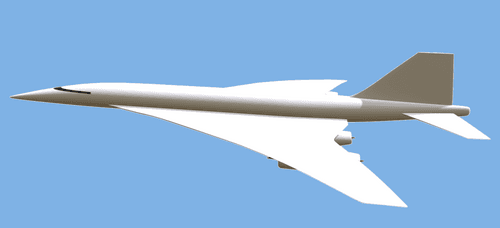
Boom Supersonic was founded on a single audacious bet — that commercial supersonic travel, dormant since Concorde's 2003 retirement, could be revived at business-class economics rather than as a subsidized status symbol. Its Overture airliner is designed to cross the Atlantic in half the time on more than 600 routes. The problem Boom has spent a decade wrestling with is not aerodynamics but propulsion: no major engine maker was willing to build a supersonic engine for a startup, forcing Boom to develop its own, Symphony.
That constraint has become the company's most interesting strategic move. In late 2025 Boom realized the core of the Symphony engine could be repackaged as a stationary industrial gas turbine, Superpower, aimed squarely at the AI data-center power crunch. By April 2026, CEO Blake Scholl said roughly 90% of company effort had shifted onto propulsion, with Symphony and Superpower sharing about 80% of their hardware. The result is a company that is now, in the near term, as much an energy-equipment startup as an aircraft manufacturer — using turbine revenue to fund the far more capital-intensive airliner it was created to build.
From Y Combinator to the first independent supersonic jet
Blake Scholl, Joe Wilding, and Joshua Krall founded Boom Technology in Denver in 2014 and were accepted into Y Combinator's W16 batch, drawing early backing from Sam Altman and Paul Graham. Japan Airlines became the first airline customer in 2017 with a $10M investment and pre-orders for up to 20 Overture aircraft, and United Airlines and American Airlines followed with orders that built the book to 130 aircraft.
The company's credibility rests heavily on XB-1, a one-third-scale demonstrator that in January 2025 became the first independently developed jet to fly supersonic. Over a 13-flight campaign that produced six supersonic runs, XB-1 validated Overture's core aerodynamics and — critically — demonstrated a 'boomless cruise' profile in which the sonic boom refracts away before reaching the ground. XB-1 was retired to Boom's Denver headquarters after its final supersonic flight in February 2025, having proven the concept but leaving the far harder full-scale aircraft and its engine still ahead.
Symphony: building an engine no one else would
Symphony is a bespoke supersonic turbofan Boom was forced to develop in-house after engine incumbents declined to serve the program. In 2025 the company selected a former hypersonic test facility at the Colorado Air and Space Port for company-owned propulsion testing and began preparing its Colorado R&D supercenter to assemble the first engine.
As of spring 2026, Boom said it was roughly two weeks from starting assembly of the first Symphony 'sprint core' — the high-pressure spool combining the high compressor, combustor, and high turbine, which come together first because they are the hardest and highest-risk components. A full sprint-core test cycle is targeted for the third quarter of 2026. Successfully lighting and running that core is the single most important technical gate in front of the company, because it de-risks both the airliner engine and the turbine business simultaneously.
Superpower: turning a jet core into a data-center turbine
Revealed in December 2025, Superpower is a 42 MW natural-gas turbine derived from the Symphony core, sharing roughly 80% of its hardware. Its pitch to hyperscalers is operational: where legacy turbines lose 20-30% of output at 110°F, Boom says Superpower holds full 42 MW output without derating and without water — attributes that matter for AI data centers being built in hot, arid regions where grid power and cooling water are scarce.
Energy-infrastructure operator Crusoe signed on as launch customer with an order for 29 turbines representing 1.21 GW of capacity, a backlog Boom values at more than $1.25 billion. CEO Blake Scholl told the AIAA AVIATION Forum in June 2026 that the first five units are targeted to ship by the end of 2027, with a production ramp aiming at 1 GW in 2028, 2 GW in 2029, and 4 GW by 2030. If it holds, Superpower would give Boom its first real revenue years before Overture could ever carry a paying passenger.
Funding, order book, and the business model
Boom has raised close to $1 billion across its life, from a 2016 Y Combinator seed through a $100M Series B in 2019 to a $300M round closed in December 2025 alongside the Superpower launch, backed by Darsana Capital Partners, Altimeter Capital, ARK Invest, Bessemer Venture Partners, Robinhood Ventures, and Y Combinator. The company remains private and pre-revenue in aviation.
Its revenue story now runs in two phases. Near term, Superpower turbines are meant to generate cash from the AI power market, converting a $1.25B+ backlog into deliveries starting in late 2027. Long term, the airliner business rests on a 130-aircraft Overture order book from American (20 firm, 40 options), United (15 firm, 35 options), and Japan Airlines (20 options), plus government and special-mission work pursued with Northrop Grumman. The elegance — and the risk — is that both businesses depend on the same engine core succeeding.
The Greensboro bind and a regulatory tailwind
Boom's pivot has left a conspicuous piece of infrastructure stranded. The $50M-plus Overture 'Superfactory' at Piedmont Triad International Airport in Greensboro, North Carolina — a 179,000-sq-ft plant completed in 2024 — sat largely idle through 2026, described in local reporting as a 'ghost hangar.' The lease with the Piedmont Triad Airport Authority permits termination if Boom employs fewer than 500 people at the site by December 31, 2026, against an original commitment to hire 1,761 workers. That deadline is now a near-term execution and credibility test the company must hit or renegotiate.
Working the other way is a major regulatory shift. On June 30, 2026 the FAA proposed 'Enabling Supersonic Overland Flight,' a rule that would repeal the decades-old U.S. ban on civil flight above Mach 1 over land and replace it with a noise-based standard allowing supersonic operation as long as ground-level sonic-boom overpressure stays at or below 0.11 psf. Because Overture is designed around exactly this boomless-cruise, Mach-cutoff technique, the proposal — following a 2025 executive order — removes the single biggest structural obstacle to a viable U.S. supersonic route network. A follow-on rule on takeoff and landing noise is expected later in 2026.
What to watch next
The next twelve months are propulsion-defined. The gating event is the Q3 2026 Symphony sprint-core test: if the high-pressure core lights and runs cleanly, Boom validates the heart of both Superpower and Overture at once; if it slips or fails, both timelines move. Watch for assembly of a fully integrated 42 MW pre-production turbine by the end of 2026, operational readiness in the first half of 2027, and the first Crusoe deliveries in late 2027 — the moment Boom would finally book turbine revenue.
Two softer signals will show whether the aircraft dream survives the detour. First, the December 31, 2026 Greensboro headcount deadline: hiring toward 500 workers would signal Overture is genuinely restarting, while a quiet lease exit would confirm the airliner has been deferred. Second, airline conviction — United CEO Scott Kirby has publicly put Overture's odds at roughly 50-50, a candid reminder that even Boom's own customers see the supersonic airliner as a coin flip that the turbine business is now being asked to bankroll.
Sources
- Aerospace Global News — Symphony sprint core assembly & 90% propulsion focus
- DataCenterDynamics — Crusoe orders 1.21 GW of Superpower turbines
- Boom Supersonic — Superpower launch & $300M funding
- Aerospace America (AIAA) — Late-2027 first turbine deliveries
- Federal Register — FAA 'Enabling Supersonic Overland Flight' proposed rule
- Business North Carolina — Greensboro Superfactory & 500-employee lease deadline
- Wikipedia — Boom Technology (history & funding)